Can AI Help When It Comes to Czech Church Registers?
An Effective—and Cheap—Czech Translator
By Andree Brower Swanson
EDITORS NOTE: Artificial Intelligence significantly assists in decoding Czech church registers through Handwritten Text Recognition and mass indexing automation. However, human verification remains essential due to limitations such as surname hallucinations and susceptibility to faded or damaged historical documents.
I’ve been dabbling with AI in my genealogy research. But like many, I have doubts about how good it is at the tasks I give it, but I did have one area I thought it might help.
Though I’ve been searching for ancestors for more than 40 years, the Czech branch of my family tree has remained barely looked at. My Czech grandmother, Rose Roznos, immigrated from Moravia at age 2 with her parents, František and Františka (Ráček) Roznos, their six children, and her maternal grandmother, Františka Adámek Ráček. The family names were later Americanized to Frank, Francis and Francis.
Of course the main reason behind this lack of research was the inability to read Czech. I wondered: could AI help me in finding those roots? Could I trust what it translated? Most people wouldn’t be able to confirm what AI told them the records said. I, however, had a way to test it.
Let’s go back in time for a minute. The opening up of Eastern Europe after the fall of the Berlin Wall changed everything, as we could now travel to eastern Europe. While stationed in Germany in the early ‘90s on an Air Force assignment, my husband and I made our first foray into then-Czechoslovakia. Later, encouraged by the trip, I wrote a letter to the Brno archives. (While my memory of how I knew to do this is foggy, I am almost certain I learned it from the Czechoslovak Genealogical Society International, where I was a member.)
Sometime later, I received a letter back from a Brno archivist. He had researched both my Roznos and Racek lines. He was writing in Czech and didn’t provide much detail, which was just as well. I had to translate his letter using a basic Czech-English language dictionary. The gist of the letter was that if I would like to see the research, I would have to send him a check for $177. Even though hubby and I were both active military, we had just had a child and that was a lot of money. But with much trepidation, I send the check and held my breath.
What I got back made my genealogy fever nearly explode: 12 pages of ancestral connections going back to the 17th century![i] I slowly did a basic translation for births, marriages and deaths, then added the names and dates to my family tree, and shared the information with my relatives. Until this year, that was all that had been done with our Czech family.
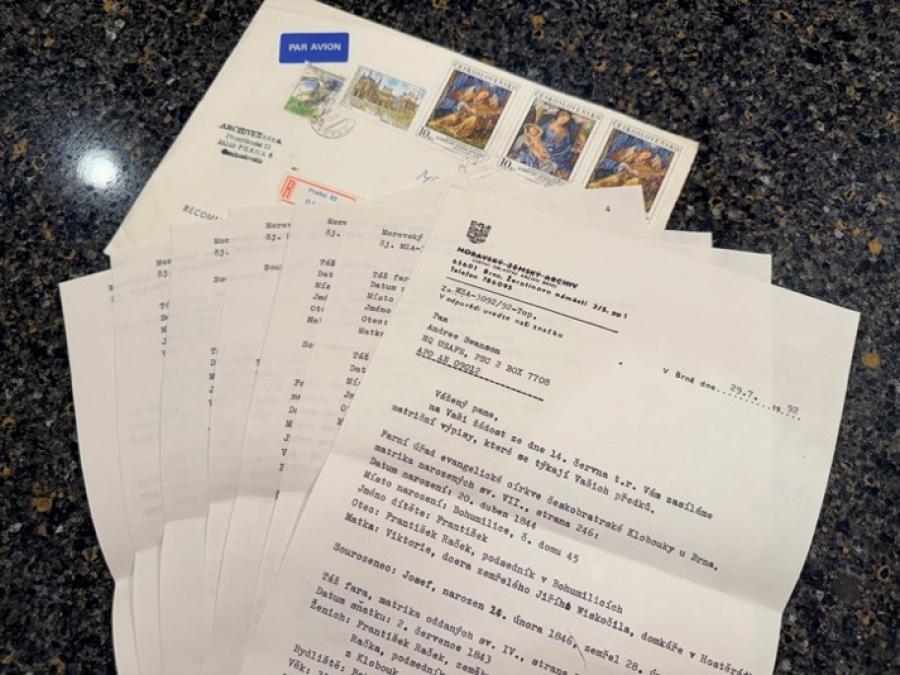
The original treasure trove of information on my family line, all written in Czech. Delivered in 1992 when the only translation tools easily available were purchased at a bookstore.
It was time to dig back into my Czech ancestry, but I was going to need more help than a poorly translated letter. I decided to test AI to see what it could do.
A quick aside about Artificial Intelligence models. I’ve used ChatGPT, Claude and Transkribus in this journey of finding Czech ancestors. For this test, Claude was the best for me. I do pay the $20 a month for more access and I’ve been using it pretty much every day since April. You may want to try free AI versions when you sign up, and depending how much you use your account, adjust what you are willing to pay. Try out different free versions. The main difference from free and paid is how much time you can use it.
Back to the research. Remember: I couldn’t read the archivist’s letter. Sure, the dates and names were there, but what was the rest of the information in it? And here’s where AI became my translator for the first time. I uploaded the document to AI and asked it to translate it and put the original words in one column and the translation in a second column. This took some time, as I had to figure out what format I wanted, but eventually I got what I wanted: two line-by-line columns, one the original Czech and the other in English. Then I went back to the original letter and made sure the names, dates and other information appeared to line up.
Seeing what was in that letter in English blew my mind again! Villages, house numbers, statements about records not being found and parents dying before their child’s marriage. I also found records I had missed in my own pathetic attempt to add the data to my tree. With the translation in hand, I headed to Matriky. (Note: this link is to the Brno archives, so if you don’t have Moravian ancestry, you’ll need to find your regional archives.)
Earlier this year, I took a CGSI webinar about how to research the Czech archives, a great presentation by Jason Cadek. (If you missed it, click on the link to watch the video yourself.) My first look at the Matriky website was intimidating, even with the English translation option turned on. But I knew the villages from my Brno archivist’s research. My target in Southern Moravia were the villages of Bohumilice (German: Bohumielitz), Velké Hostěrádky (German: Hostraditz), Kašnice (German: Kaschnitz), Násedlovice (German: Nasedlowitz) and Klobouky (German: Klobouk). Having the German version of those villages is important. As we all know, Moravia was part of Austria prior to 1918. During the 19th century where I would start my search, the registers are in German until 1878. After finding the Klobouky u Brna registers where all these villages reside, I hoped all I had to do was look for dates and find the records the archivist had abstracted.
My Brno archivist started his research with the Raček side of my family, but like every genealogist, I jumped down the letter and found the Roznos side, since that was my paternal line. (I was particularly interested in this line because I had a Czech native tell me that the name Roznos wasn’t Czech at all. However, with the archivist’s research all the way back to 1680, that definitely wasn’t true. A rare name for sure!)
I found the first record by searching for the date. Though the letter had the register and page numbers for each record in it, when the register was digitized, someone made a decision to consecutively number the registers, so the source data didn’t match. But the dates were sufficient for finding the record.
And this is where AI became critical. What I saw was a record I could barely make out the bride and groom’s names.[ii] I took a closeup screenshot of the entry and a full page shot of the web page itself. Then I gave both to Claude and asked for a translation. My prompt was simple:
“This should be the marriage of Frantisek Roznos and Eva Burschika, married in Nasedlovice on 26 February 1843. Confirm that information and provide a Czech and English translation, aligning with the fields at the top of the original and English versions. If there is a question of what it says, please note that.” [Misspelled Czech words are mine.]
The response I got was very thorough, too thorough to put in this article. But I will note that Claude wouldn’t confirm that the bride’s last name was Burschika. When I asked for a summary that I could use in Family Tree Maker and on FamilySearch notes, this is what I got:
- Marriage of František (Franz) Roznos and Eva, celebrated 26 February 1843 at Velké Hostěrádky.
- Groom František Roznos, of Hostěrádky house No. 20, aged 35, single, Helvetic Confession, private (Gemeiner) in the Imperial-Royal 71st Line Infantry Regiment (k.k. 71. Carl 3. Lin. Inf. Regiment); son of the late Josef Roznos, half-landholder (Halblehner, půlláník) of Hostěrádky, and of his mother Kateřina, née [surname not legible], both of Hostěrádky.
- Bride Eva, of Hostěrádky house No. 102, aged 30, widow, Helvetic Confession, widow of the late Tomáš (Thomas) [surname not legible], cottager (Häusler) of Hostěrádky; daughter of the late Tomáš (Thomas) Buršík[?], cottager (Häusler) of Násedlovice, and of her mother Petronila, née [surname not legible], of Násedlovice.
- Witnesses František Buršík[?], cottager of Klobouky No. 225, and František Englich[?], cottager of Hostěrádky No. 54. Officiant [name not legible], pastor.
Original record in German. Moravský zemský archiv v Brně, accessed via ACTA PUBLICA, www.mza.cz/actapublica.

To access this image you must a logged-in member.
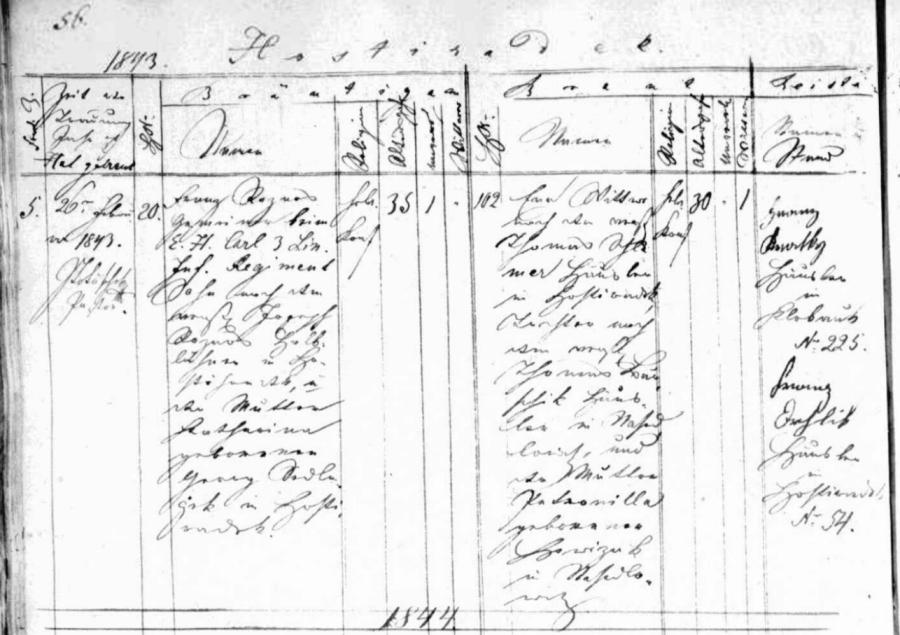
The marriage record of Franz Roznos and Eva Burshika, 20 February 1843, was written in German Kurrent, far too difficult for an amateur Czech researcher to read. AI was able to read enough of the record that I could confirm it matched with the original Brno archivist's research.
The question marks were part of my prompt to Claude. I didn’t want it guessing on names or other information in records. As a result, a lot of my research does have question marks, but for the most part, they didn’t affect the primary vital data. (I also found Eva’s birth record, so ultimately, I was able to confirm her surname was Buršík, Burschika being the German feminine spelling.)
Even though the archivist had clearly noted house numbers, I soon realized how important that little detail was. Families tended to stay in the same houses. Instead of searching for capital letters that matched the person I was seeking—my only way of “reading” the cramped, barely legible script—I could look for house numbers. The priests added these numbers to the entries beginning in the 1760s. Though it was helpful, it wasn’t easy. I did a lot of running screenshots through AI, especially when the records weren’t separated by village, and asking if it was the record I was looking for—and I was wrong a lot.
As I moved through these vital records, I began to get a feel for the registers, learning a few things along the way. For instance, the books were written in Latin from when they first started through 1788, and they were all Catholic registers. Sometimes the names were Czech (Jiří), and others were in Latin (Georgius). Then from 1791 through 1878, the registers were in German, but with the Reformed Protestant worshippers showing up in their own books. The names in these were written as German names, e.g. Wilhelm for Vilém. Finally, it was Czech spelling from 1878/1879 onward. Claude did very well on Latin and Czech, but the German Kurrent tripped it up quite a bit. There are a lot more question marks in those translation notes, but those doubts made me confident I wasn’t getting made-up crap!
Another interesting trend that AI noticed and I didn’t: the same godparents would show up for all children of the same parents, helping confirm that children with parents who had common names, were the right parents, and also to separate generations where the father and son with the same first name were having children at the same time.
Claude needed help occasionally on dates, not because it couldn’t read them, but because the years often didn’t appear on the pages I gave it. I made sure the event date was in the filename. By telling AI that it should pay attention to those file dates when abstracting, I got translations that included the full dates.
| Row | Czech Transcription | English Translation |
| 141 | Táž fara, matrika oddaných sv. IV., strana 56: | Same parish; Register of Marriages, Vol. IV, p. 56: |
| 142 | Datum sňatku: 26. únor 1843 | Date of marriage: 26 February 1843 |
| 143 | Ženich: František Roznos, prostý voják od pěšího regimentu arcivévody Karla, syn zemřelého Josefa Roznose, půlláníka v Hostěrádkách, a jeho manželky Kateřiny, rozené Sedláčkové z Hostěrádek | Groom: František Roznos, common soldier of the Infantry Regiment of Archduke Karl, son of the late Josef Roznos, half-hide farmer in Hostěrádky, and his wife Kateřina, née Sedláčková, of Hostěrádky |
| 144 | Bydliště: Hostěrádky, č. domu 20 — Věk: 35 let | Residence: Hostěrádky, house no. 20 — Age: 35 years |
| 145 | Nevěsta: Eva, vdova po zemřelém Tomáši Schlamerovi, domkáři v Hostěrádkách, dcera zemřelého Tomáše Burschika, domkáře v Násedlovicích, a jeho manželky Petronily, rozené Howěžákové z Násedlovic | Bride: Eva, widow of the late Tomáš Schlamer, cottager in Hostěrádky, daughter of the late Tomáš Burschik, cottager in Násedlovice, and his wife Petronila, née Howěžáková, of Násedlovice |
| 146 | Bydliště: Hostěrádky, č. domu 102 — Věk: 30 let | Residence: Hostěrádky, house no. 102 — Age: 30 years |
This AI-produced spreadsheet of the translation was made to easily check the original letter to the transcription, allowing me to make sure it had copied the original. A few diacritical marks had to be fixed, but otherwise, the spreadsheet’s information was good.
When my eyes disagreed with Claude’s interpretation, particularly when I had other records saying differently, Claude might disagree but would eventually back down and accept that I was right. Yes, you will argue with a machine when you’re certain you’re right!
This human-machine partnership aided me enough that when I finished the archivist’s records, I went back to find the records the archivist didn’t. In the slightly more than three months of this project, I found 479 records to attach to my tree. In addition, I added every record to FamilySearch, with extensive source and translation notes provided by AI. I have no doubt that even if Claude failed to translate the document properly, future genealogists can see the record themselves and correct the information.
Claude assisted me in other ways as well. It gave me the history of Austria when I asked to explain what my ancestor did in the military, and why my ancestors were Catholic one day, and Protestant the next. It created a spreadsheet of house numbers so that I could track what family lived in a house at a period of time, then gave me the link for where I could search Czech census and land records—again, using house numbers. Most importantly, it spelled my Czech ancestors’ names the way Czechs would spell them, which I dutifully copied and pasted into my tree since I don’t know the computer shortcuts for the diacritical marks.
While I only fully tested one model, I can positively ascertain that at least Claude can translate and will admit when it can’t read something, so no hallucinations. I recommend that if you do not read Czech, German or Latin, then you need to investigate AI as an inexpensive assistant to help you in your research.
[i] Jarmila Topilová (Moravský zemský archiv v Brně, Státní oblastní archiv Brno) to Andree Swanson, letter, 27 July 1992, Ref. MZA-3092/92-Top., re: Racek/Roznos/Wiskočil family matriční výpisy; privately held by Andree Swanson, 2026.
[ii] Hoštěrádky (Hustopeč, Moravia, Czech Republic), Traungs-Buch [marriage register], 1843, entry no. 5, marriage of Franz Roznos and Eva Burschika [Buršíková], 20 Feb 1843; digital image, Book 3714, frame 51 of 77, "ACTA PUBLICA," Moravský zemský archiv v Brně (Moravian Provincial Archive in Brno), Sčítání lidu / Matriky, mza.cz/actapublica : accessed 2 May 2026.
