Exciting news for anyone researching roots in Subcarpathian Rus!
Exciting news for anyone researching roots in Subcarpathian Rus!
The 1921 Czechoslovak Census records for Subcarpatho-Rus (Podkarpatská Rus) are available online and fully accessible to browse. For CGSI with Rusyn roots, this collection is an absolute goldmine for tracking ancestors during the crucial interwar period.
Housed on the Hungaricana digital library platform, these images provide a rare, deeply detailed look into the families living in the easternmost province of the first Czechoslovak Republic.
🗂️ What You Can Find in These Records
The 1921 census is incredibly rich, capturing a snapshot of a population recovering from WWI and adapting to a new nation. On each sheet, you can uncover:
- Full names of every household member.
- Exact birth dates and birthplaces.
- Marital status and relationship to the head of the household.
- Citizenship, nationality/ethnicity, and religion (vital for navigating complex border shifts and ethnic identities like Rusyn, Ukrainian, Hungarian, Jewish, and Czech).
- Occupations and literacy status.
- Detailed residence information, including house numbers.
🌐 How to Access the Collection
- You can jump straight into the digital archives here:
👉https://library.hungaricana.hu/en/collection/KANepszaml_001/
💡 Quick Tips for CGSI Members:
- Browse by District: The collection is organized by administrative districts (okres / járás). Knowing the village name and its corresponding district will help you drill down to the right book.
- Language Navigation: The Hungaricana interface can be switched to English (using the en link in the URL), making it easier to navigate the collection trees.
- Handwriting Hurdles: The forms themselves are bilingual (often Czech and Rusyn/Cyrillic or Hungarian). Keep a translation guide or alphabet chart handy as you scan the handwritten entries.
Have you found your family in the 1921 Podkarpatská Rus census yet? Share your discoveries, breakthrough moments, or formatting tips! 👇
#Genealogy #CzechoslovakGenealogy #SubcarpathianRus #RusynRoots #FamilyHistory #CGSI #1921Census #Hungaricana

How did house numbers work in the Czech lands?
How did house numbers work in the Czech lands?
An excellent resource for those just getting started in Czech genealogy is the Czech Genealogy for Beginners blog.
Here is a post everybody should read from the site. It answers the following questions about house numbers:
- When did house numbering begin and why?
- How were house numbers first given?
- How did the systems change over time?
- How frequent were house renumberings and how did that work?
- How can I know which house number I'm looking at?

"Did Catholics write their genealogies on the insides of their family bibles?"
"Did Catholics write their genealogies on the insides of their family bibles?"
I have personally wondered this, and posed this same question to many different people both in the United States and abroad.
It seems that the answer is, "Not traditionally, no. This is more of a Protestant tradition."
But there are exceptions. On a visit to NCSML I was allowed to look at the stacks in the back of the library, and I found a Czech prayer book with a written genealogy in it.
Perhaps we can discover whose it is?
Or perhaps you have more insight into this issue?


Saint Vitus Saints
Saint Vitus Saints
If you've been to Prague, most likely you've been to St. Vitus Cathedral (I mean, it's rated #1 of 1,220 things to do in Prague on Trip Advisor for a reason). It's a prominent historical and religious site worth seeing for the art, majesty, culture, and experience.
Here is a photo of some of the stained glass (though it's not by a long shot the most popular piece of stained glass art in the place; that spot is probably reserved for the masterwork of Mucha which you can look at here).
When I was in Prague, I tried to take the best photo that I could of some of the stained glass.

Somebody on Wikipedia took a much better photo.
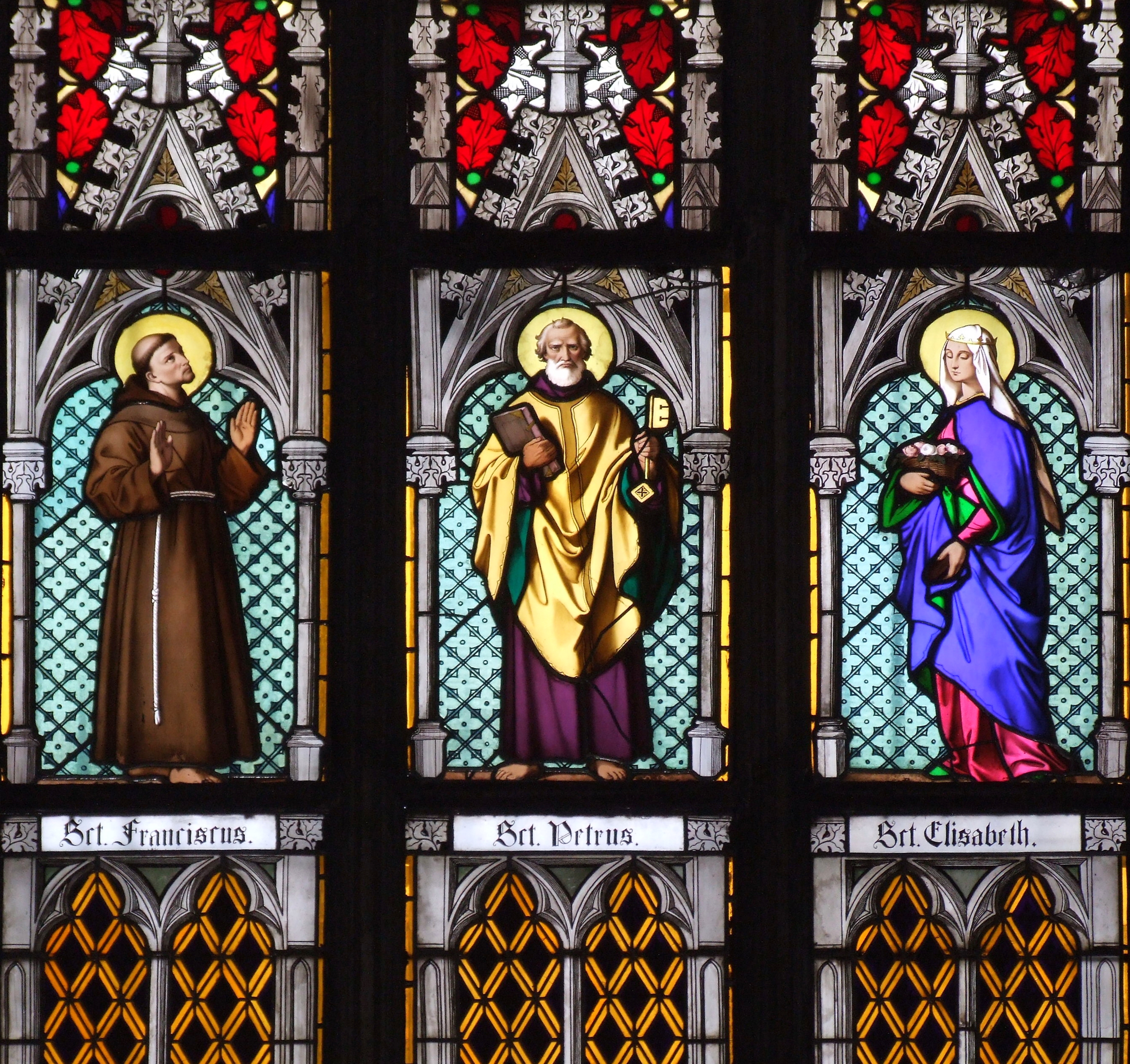

Each of these represents an important figure in Catholic iconography and culture. It is worth knowing a little bit more about each of them. Here's a place you might like to start about Svatý František z Assisi, Svatý Petr, and Svatá Alžbětá. If you are using the Chrome browser, you can right click and these Czech Wikipedia articles will give you a translation to English. You'll probably be interested to note that they are not exactly the same as the English articles; if you have Czech ancestors, there's no doubt that you have at least one ancestor named František. Why not learn more about the history of the name?
In Czech, the abbreviation for Saint is not "St." but "Sv." - which is very important general knowledge to have when reading the land records!
