A Memoir from World War I's Eastern Front
A Memoir from World War I's Eastern Front
In early 1919, Polish Army officer Stanislaw Kawczak was responsible for border negotiations in a disputed area of Silesia following an armed conflict between Czechoslovakia and Poland over the city of Cieszyn. Brought in blindfolded to the Czechoslovak Army camp for talks, Kawczak shared dinner and beer with his former battlefield opponents after the official business was done.
Learn more on Saturday, May 15 at noon Central Time as Kawczak’s grandson Andrew Kavchak of Canada talks about a new English translation of his grandfather’s book Dying Echos: Memoirs of the War 1914-`1920, an account of the 20th Infantry Regiment of the Austrian-Hungarian Army during World War I, and Kawczak’s successor Polish unit in 1919-1920 during the Polish-Soviet War.
Kawczak’s unit served in the same Carpathian foothills area east of Krakow as the Austrian-Hungarian 98th infantry Regiment, an ethnically Czech unit that defected to Russia in early 1915. Dying Echos was originally written in Polish and in 1920s Poland held in same literary regard as Farewell to Arms and All Quiet on the Western Front were for English-speaking audiences.
Kawczak was killed during the 1940 Katyn Massacre by the Soviet Union. His book was banned in Poland and Czechoslovakia during the Communist period.
The May 15 talk is sponsored by the American Council for Polish Culture
https://global.gotomeeting.com/join/902135013

How did house numbers work in the Czech lands?
How did house numbers work in the Czech lands?
An excellent resource for those just getting started in Czech genealogy is the Czech Genealogy for Beginners blog.
Here is a post everybody should read from the site. It answers the following questions about house numbers:
- When did house numbering begin and why?
- How were house numbers first given?
- How did the systems change over time?
- How frequent were house renumberings and how did that work?
- How can I know which house number I'm looking at?

Saint Vitus Saints
Saint Vitus Saints
If you've been to Prague, most likely you've been to St. Vitus Cathedral (I mean, it's rated #1 of 1,220 things to do in Prague on Trip Advisor for a reason). It's a prominent historical and religious site worth seeing for the art, majesty, culture, and experience.
Here is a photo of some of the stained glass (though it's not by a long shot the most popular piece of stained glass art in the place; that spot is probably reserved for the masterwork of Mucha which you can look at here).
When I was in Prague, I tried to take the best photo that I could of some of the stained glass.

Somebody on Wikipedia took a much better photo.
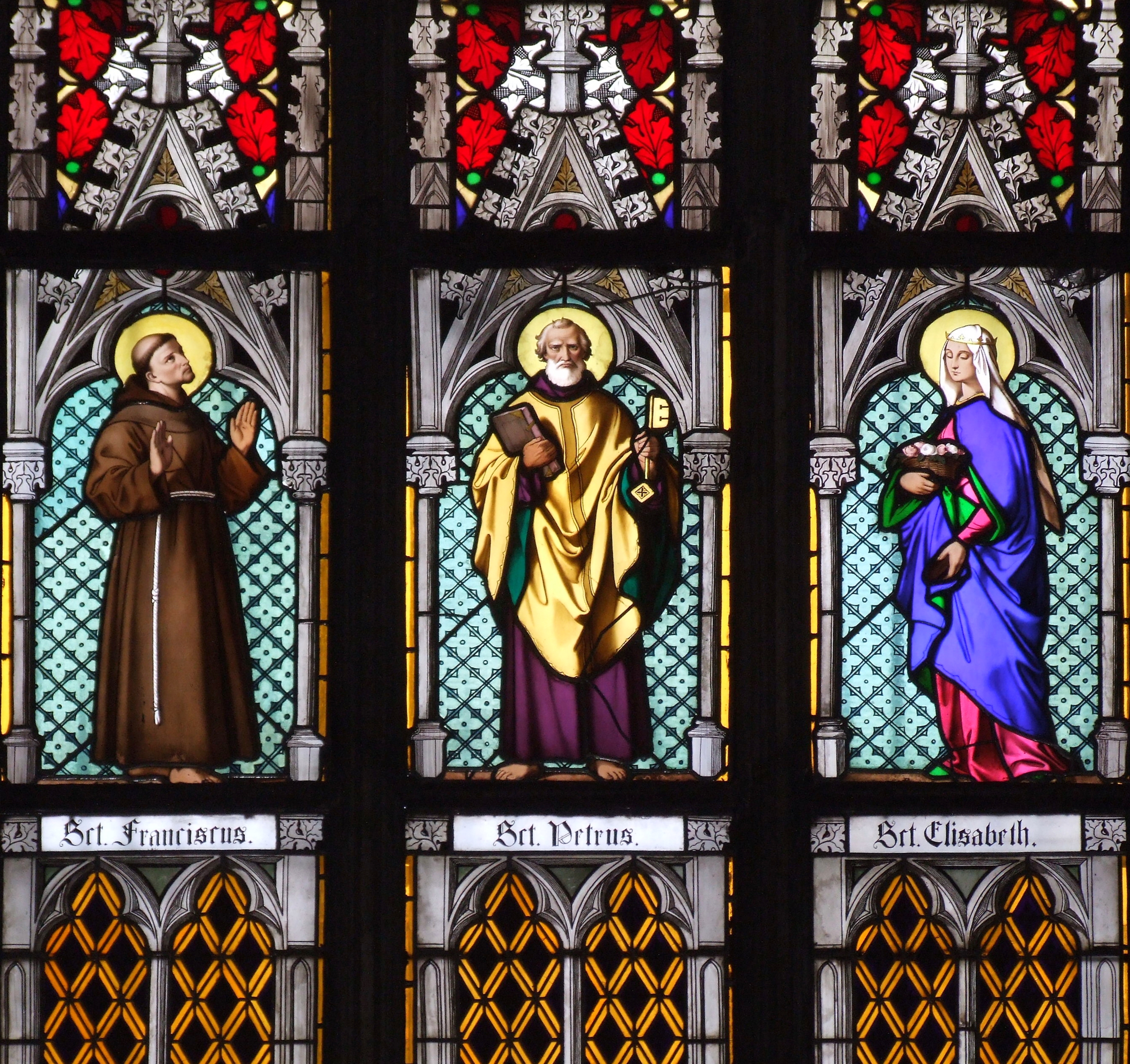

Each of these represents an important figure in Catholic iconography and culture. It is worth knowing a little bit more about each of them. Here's a place you might like to start about Svatý František z Assisi, Svatý Petr, and Svatá Alžbětá. If you are using the Chrome browser, you can right click and these Czech Wikipedia articles will give you a translation to English. You'll probably be interested to note that they are not exactly the same as the English articles; if you have Czech ancestors, there's no doubt that you have at least one ancestor named František. Why not learn more about the history of the name?
In Czech, the abbreviation for Saint is not "St." but "Sv." - which is very important general knowledge to have when reading the land records!

Jaroslav ze Šternberka... did not exist
Jaroslav ze Šternberka... did not exist

|
O! Jaroslav, like an eagle flying, solid steel on his mighty chest, beneath the steel lies bravery, valor, beneath the helm his keen fame; from the glowing sight of his cloak from his hot glowing gaze his boisterousness cries Engraged rushing forth, like a hot-tempered lion when the warm blood sets him aflame, then shot, he rushes after the hunter; so they fly, determined against the Tartars, the Czechs behind him, like a hailstorm.
Sinking cruelly on Kubla Khan though the clash is mighty fierce. The two clashing their javelins, breaking both with a great crack. Jaroslav, with his steed, all covered with blood, seizes Kubla Khan with his sword, and slashes from the shoulder across to the hip, so, soulless he falls among the carcasses, a quiver with a bow rattling. |
O fi! Jaroslav, lich þe eagle flien metalkinde anuppe his mighti brest, ther-under umbeleien pruerie, wighthede ther-under umbeleien þe helme smerte fame; fro radiant þe lichte of his robe ful lyflich he forth-rushinge angriwise þe cri ben souned to myne erys lik to þe hateful and þe fearlac lion whenne þe warme blood hem upwerd-borneth, nou-then shot, purseuen upon þe hunter. So flien they, suþe stronge ayenes þe Tartars, Bohemyans behynd, so thik as hail.
Cruwelly ther-upon yon Kubla Khan al-though þe feiht folliche myghty be, twein theire chafeveleyns anhitten, breken asonder wythe a mighti noyse. Jaroslav and destrer, blood overputten, Kubla Khan with sworde he seseth he dasheth from-shulder þe hipe thoum-to, where-so he lieth atuyx þe cariones, þe victen whiver soun of his yenden. |
"Ajta! Jaroslav jak orel letě:
tvrdú ocel na mohúcech prsech
pod ocelí chrabrosť, udatenstvie,
pod helmicú velebyster věhlas;
jarota mu z žhavú zrakú pláše.
Rozkacen hna, jako lev drážlivý,
když mu teplú krev sě udá zřieti,
tehdy nastřelen za lovcem žene:
tako vluti sě, vz-Tatary trči;
Češie za niem, jako krupobitie.
Vrazi kruto na Kublajevica,
i by pótka ovšem velelutá:
srazista sě oba oščepoma,
zlomista je oba velím praskem.
Jaroslav, ves ve krvi s ořem sbrocen,
mečem Kublajevica zachváti,
ot ramene šúrem kyčlu protče;
takož spade bezduch mezi mrchy,
zarachoce nad niem túlec s lukem." -
I was reading this article when I discovered that the mythical 13th century legend Jaroslav ze Šternberka did not exist.
Jaroslav... who?
I had not heard of this particular person before, but one can't get very far into Czech history before hearing the name Šternberk. (It's Sternberg in English, because apparently we are allergic to diacritical marks).
In fact, when we visited the Czech Republic in 2017, we stayed one night at Zámek Jemniště, which is still owned by a branch of the Šternberk family. They gave us a personal tour, and it was one of the highlights of our trip. I highly recommend it! Our fictitious 13th century Jaroslav apparently even appears in the 19th century art in this castle, too!
Jaroslav was allegedly sent to Moravia by King Václav (you know, Good King Wenceslaus?) with 8,000 Czechs. He gathered the Moravian forces into Olomouc, totaling 12,000 men. They defended themselves from Tatar attack there for a long time, and then when the time was right, attacked furiously - and won a decisive and glorious victory against the Tartars (as was described so eloquently in the Rukopis královédvorský poem from above).
Except that Rukopisy královédvorský was a 19th century forgery of a 13th century document, so none of this actually happened. The whole thing was supposedly discovered in 1817 (then transribed and printed in 1819) to look like it was from the 1220's.
I mean, there are multiple other real people named Jaroslav ze Šternberka, but the one who heroically defeated the Mongols? No. Yet many, many people were fooled, including artists who went to great lengths to paint intricate frescoes about the subject. It was a popular topic for 19th and very early 20th century artists, poets, and writers, fitting nicely into the Romantic ideals of the Neo-Baroque style.
The manuscript even fooled František Palacký, famous historian and politician.
I personally think that somebody ought to make a movie about this.
Or at least a Wikipedia article in English...
In case you're wondering, the first translation was mine (with help), and the English to medieval English translation was entirely mine, with the help of this awesome dictionary. The best part? It doesn't even have to be proper "ye middle Englishe" - it just has to be passable!
And yes. If you're wondering, I had wayyyyy too much fun with this. It doesn't really get much better than forged epic medieval poetry.
